Reciprocating Boiler Solutions for Biomass Combustion by ZOZEN Boiler
The most distinctive feature of a reciprocating boiler lies in its grate movement mechanism. Unlike traditional fixed or chain grate systems, the reciprocating grate moves in alternating forward and backward motions. This movement loosens the fuel layer, prevents compaction, and continuously exposes fresh fuel surfaces to combustion air. As a result, the reciprocating boiler is particularly effective when handling biomass fuels with high moisture content or irregular structure.
From a combustion perspective, the reciprocating boiler enables staged fuel processing directly on the grate. Biomass fuel is gradually dried, ignited, and burned as it advances through the furnace, which improves burnout rate and reduces unburned carbon losses. ZOZEN Boiler integrates this combustion principle with carefully designed furnace geometry and air supply systems, ensuring that each reciprocating boiler operates reliably under demanding industrial conditions.
Another important characteristic of the reciprocating boiler is its operational stability. The controlled mechanical movement of the grate helps maintain consistent fuel feeding and combustion thickness, reducing sudden fluctuations in furnace temperature. This stability directly translates into more consistent steam output, which is critical for industries such as paper production, textiles, and building materials. ZOZEN Boiler applies mature engineering experience to align reciprocating boiler design with continuous production requirements.
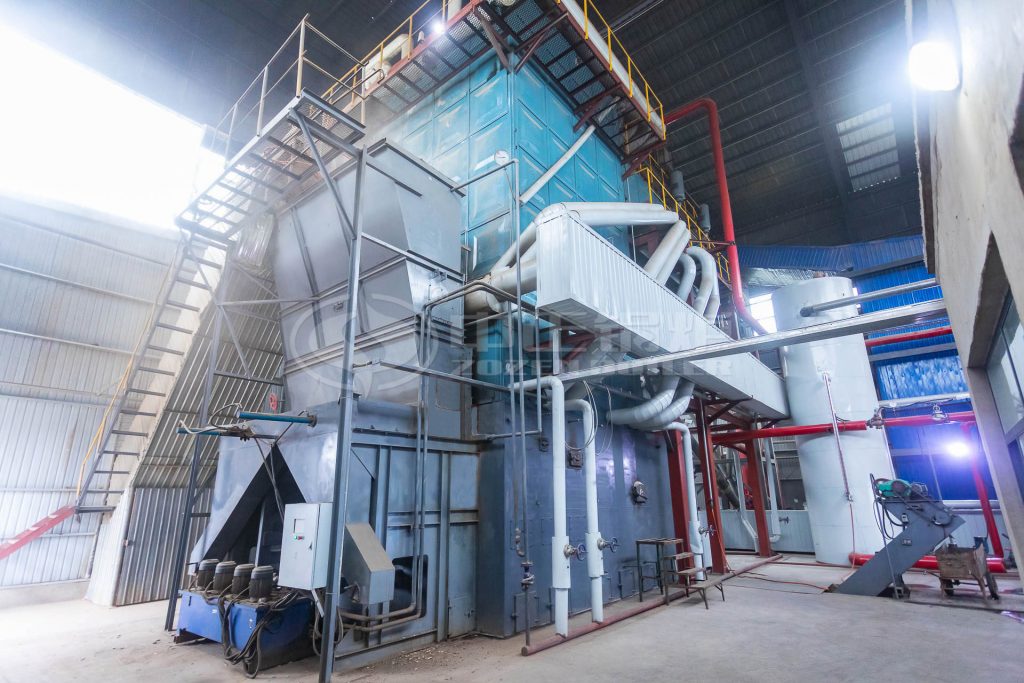
ZOZEN DZW Reciprocating Grate Biomass Boiler: Technology and Advantages
The DZW series reciprocating boiler is ZOZEN Boiler’s specialized solution for biomass steam generation using difficult fuels. This boiler adopts a water-tube structure combined with a reciprocating grate combustion system, allowing it to handle biomass loose materials such as wood chips, rice husk, corn cobs, sawdust, and other agricultural residues with high moisture content.
A core advantage of the DZW reciprocating boiler is its grate structure and motion control. The reciprocating grate uses segmented grate bars driven by a mechanical transmission system, creating a continuous agitation effect across the fuel bed. This action effectively breaks fuel agglomeration caused by moisture, prevents slag formation, and ensures that fuel moves steadily through the furnace. By maintaining a loose and active fuel layer, the DZW reciprocating boiler significantly improves ignition conditions and combustion completeness.
The boiler is equipped with an independent air chamber design arranged along the length of the grate. This structure enables precise zoned air supply, matching the different air demand characteristics of fuel drying, combustion, and burnout stages. For high-moisture biomass fuels, this refined air distribution enhances ignition stability and improves overall thermal efficiency. With proper operation, the thermal efficiency of the DZW reciprocating boiler can exceed 86 percent, supporting effective energy utilization without additional fuel pretreatment.
In addition, the furnace of the DZW reciprocating boiler is designed with densely arranged water-cooled wall tubes, which increase radiant heat absorption and help stabilize furnace temperature. This configuration not only improves heat transfer efficiency but also protects furnace walls from thermal stress during long-term operation. Combined with automated fuel feeding, ash discharge, and slag removal systems, the DZW reciprocating boiler offers reliable performance with reduced operator workload.
Application Case: Reciprocating Boiler Solving Biomass Challenges in the Paper Industry
In paper manufacturing, steam is a core energy source for processes such as drying and sheet forming, where stable heat supply directly affects product quality and production efficiency. A paper company faced persistent challenges related to biomass fuel utilization, including high moisture content in loose biomass materials, incomplete combustion, and low overall thermal efficiency. Traditional boilers struggled to burn these fuels effectively, often requiring additional fuel drying measures that increased operational costs.
Incomplete combustion led to significant heat loss, resulting in elevated steam generation costs and unstable boiler operation. These issues made it difficult for the company to maintain consistent production performance while controlling energy expenses. In response to these industry-specific challenges, ZOZEN Boiler provided a customized DZW series reciprocating boiler solution to address the root causes of inefficient biomass combustion.
The reciprocating grate system played a decisive role in overcoming high-moisture fuel limitations. Through its distinctive mechanical motion, the grate forcefully turns and loosens the fuel bed, effectively breaking fuel bonding and preventing coking caused by excessive moisture. This ensured that biomass fuel could advance smoothly across the grate and remain evenly distributed throughout the combustion process.
At the same time, the independent air chamber design enabled precise air supply along the grate length. By adjusting airflow and air temperature to match the drying, ignition, and burnout stages of high-moisture biomass fuels, the reciprocating boiler significantly improved fuel ignitability and burnout rate. As a result, the paper company was able to eliminate additional fuel drying steps, stabilize steam output, and reduce unnecessary energy losses.
The implementation of the DZW reciprocating boiler allowed the paper company to achieve more efficient biomass utilization while maintaining stable steam supply for its production lines. This case demonstrates how reciprocating boiler technology can effectively address real industrial challenges associated with difficult biomass fuels.
Why Choose ZOZEN Reciprocating Boiler Solutions
ZOZEN Boiler’s reciprocating boiler solutions are developed with a clear focus on fuel adaptability, operational stability, and long-term reliability. By combining advanced reciprocating grate technology with optimized furnace design and precise air distribution, ZOZEN ensures that each reciprocating boiler performs consistently under complex fuel conditions.
Beyond equipment design, ZOZEN provides comprehensive technical support, including system design optimization, commissioning guidance, and operational training. This integrated approach allows customers to fully realize the advantages of the reciprocating boiler throughout its service life rather than facing performance uncertainties after installation.
Conclusion
The reciprocating boiler has become an effective solution for industries that rely on biomass fuels with high moisture content and variable characteristics. Through its mechanical grate movement and refined air supply strategy, the reciprocating boiler enables stable combustion and efficient energy utilization where conventional systems fall short.
ZOZEN Boiler’s DZW series reciprocating boiler demonstrates how targeted engineering and application-focused design can transform challenging biomass fuels into reliable thermal energy. For enterprises seeking a dependable reciprocating boiler that supports stable production and improved fuel efficiency, ZOZEN Boiler offers proven solutions built on technical expertise and real industrial experience.
Our Cases


Hot Sales
Hornor Customers


LEAVE A MESSAGE
For all inquiries, please fill in the form below (* are required) to send us a brief message, and we will get back to you as soon as possible.